The Hidden Cost of ‘Pwede Na’ in Philippine Food Service
“Pwede na” is one of the most familiar phrases in Filipino work culture — and one of the most harmful in food service.
It may sound practical. Efficient. Even harmless.
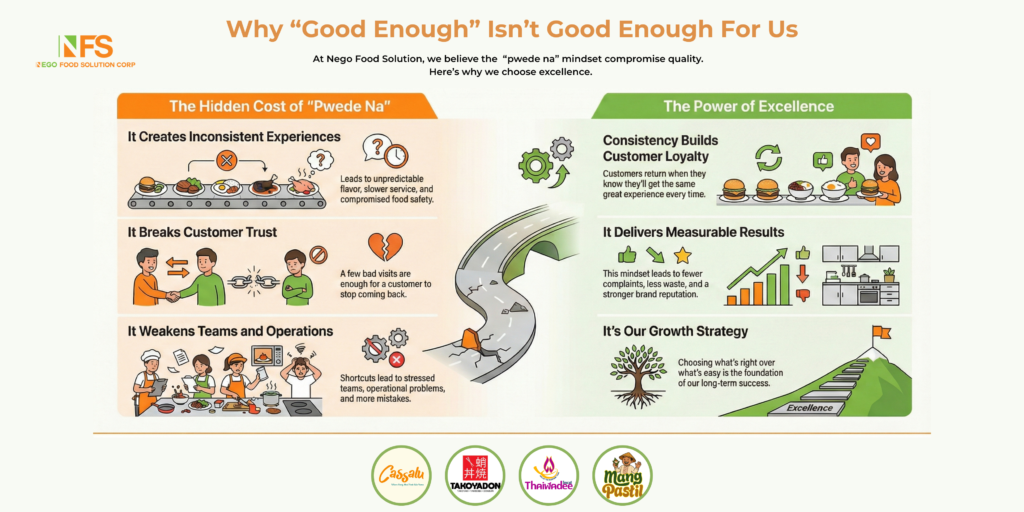
But inside a food company, “pwede na” quietly creates consequences that customers feel long before anyone notices the cause:
• inconsistent flavor
• slower service
• compromised safety
• stressed teams
• operational problems
• loss of customer trust
In food service, every plate is a promise.
“Pwede na” isn’t just an attitude — it’s a risk.
This is why at Nego Food Solution, “pwede na” has no place in our kitchens, stores, or leadership.
Excellence Isn’t Perfection — It’s a Choice
Excellence isn’t about doing things flawlessly.
It’s about choosing what’s right, especially when it’s inconvenient, tiring, or unnoticed.
At Nego Food Solution, excellence shows up in the everyday:
• careful ingredient preparation
• precise temperature checks
• hands-on team training
• clean-and-safe routines
• fast, reliable service
• systems followed the same way, every time
Excellence isn’t a moment — it’s a mindset.
And shortcuts are the first cracks that make systems fall apart.
‘Pwede Na’ Makes Experiences Inconsistent — and Inconsistency Breaks Trust
Customers walk into a food business expecting:
• the same flavor every visit
• the same speed
• the same cleanliness
• the same experience
But “pwede na” slowly erodes this trust:
• a few grams off → flavor changes
• skipping sanitation → safety risks
• rushing preparation → quality loss
• ignoring processes → longer queues
A customer may forgive one bad visit.
Two or three — and they move on.
Consistency creates loyalty.
And “pwede na” is the fastest way to lose it.
How We Teach Teams to Reject ‘Pwede Na’
People aren’t naturally consistent — they become consistent when they understand the why behind what they do.
This is why Nego Food Solution invests in a system of training built on clarity, purpose, and pride:
- Clear, non-negotiable standards
Teams learn not just steps but meaning. - Real-world scenario training
Because confidence comes from practice, not memorization. - Leadership that guides, not pressures
Supervisors learn how to reinforce standards with empathy. - Constant feedback and coaching
Focused on improvement — never fear. - A culture that values pride over shortcuts
We teach teams to care about their work, not just complete it.
This is how we turn everyday habits into identity — and identity into excellence.
The Business Results of Rejecting ‘Pwede Na’
Choosing high standards over convenience creates measurable impact:
• fewer complaints
• faster service
• fewer mistakes
• stronger brand reputation
• more confident franchise partners
• better team morale
• lower waste and inefficiencies
Excellence strengthens businesses.
But more importantly, it strengthens people.
Excellence Protects Every Nego Food Solution Brand
Across all our concepts — Japanese, Thai, Filipino, American, and experiential dining — the promise remains the same:
The customer deserves the best version of the brand, not the most convenient version of the process.
When people choose excellence, customers feel it even if they can’t explain it.
That’s what creates admiration.
That’s what builds trust.
That’s what drives long-term success.
Why We Reject ‘Pwede Na’ — Even as We Grow
Growth introduces pressure.
Pressure tempts shortcuts.
Shortcuts destroy consistency.
And consistency is the foundation of everything we’re building.
Saying no to “pwede na” is not just a belief — it’s a growth strategy.
The bigger we become, the more intentional we must be.
Our future depends on leaders who care enough to insist on doing things correctly.
Excellence Is a Daily Decision
We don’t reject “pwede na” for branding.
We reject it because our customers, partners, and teams deserve better.
Excellence is how we:
• protect our reputation
• build the next generation of food brands
• create opportunities that last
• elevate Filipino dining
The future belongs to companies that choose what’s right over what’s easy.
This is why we still say no to “pwede na.”
And why we always will.